Comedy Is the Hardest Genre to Storyboard
Drama forgives loose timing. Action forgives loose framing. Comedy forgives neither.
A joke that works on the page can die on screen if the camera is in the wrong place, the cut comes a beat too late, or the framing reveals the punchline too early. The difference between "funny" and "not funny" is often a quarter-second of timing or six inches of camera placement.
That's why comedy storyboarding matters more than most directors think. You're not just planning shots — you're planning the delivery mechanism for every joke.
The Three Types of Visual Comedy
1. Framing Comedy (What's in the Shot)
The joke is in what the audience sees — juxtaposition, scale, positioning, or visual incongruity.
Example: A character delivers a serious monologue. The camera is on their face, tight and dramatic. Then the shot widens to reveal they're talking to a rubber duck in a bathtub.
Storyboard approach: Board the setup frame (tight, serious) and the reveal frame (wide, absurd) as consecutive panels. The comedy is in the cut between them — the sudden reframe. Note the exact moment the wider framing appears.
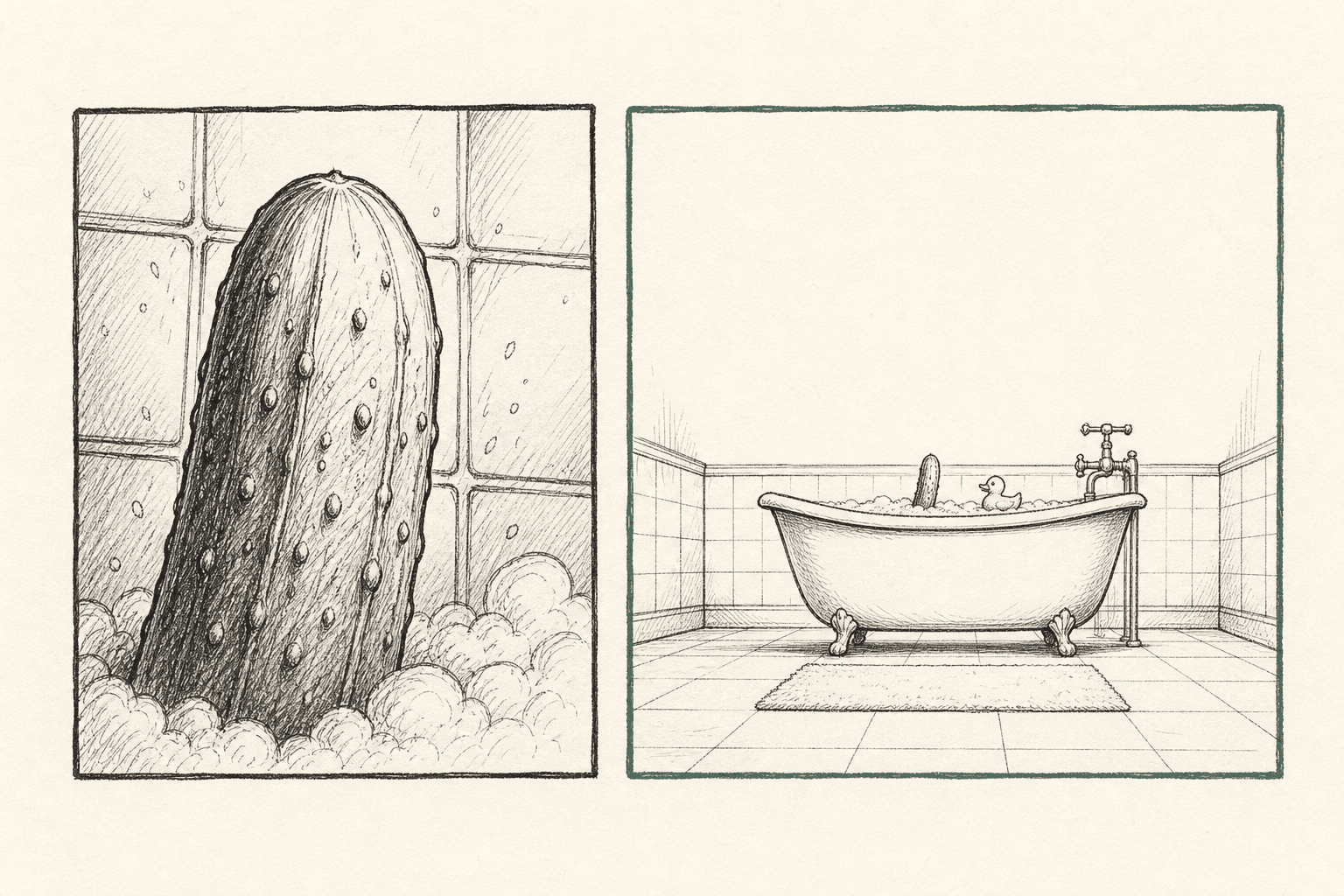
Key principle: Control information. The audience should see exactly what you want them to see, exactly when you want them to see it. The storyboard is your information control map.
2. Timing Comedy (When the Cut Happens)
The joke is in when the audience sees a reaction, a cut, or a held shot. This is editing comedy — and it's designed in the storyboard.
Example: Character A says something absurd. Hold on Character B's face for an uncomfortably long beat. No reaction. No dialogue. Just... the face. Then B finally responds.
Storyboard approach: Board B's reaction shot with a duration note: "HOLD 3-4 seconds. No movement. The discomfort IS the joke." Without this note, your editor might cut away after 1 second and kill the bit.
Key principle: Comedic timing in film is editorial timing. The storyboard pre-designs the edit.
3. Physical Comedy (What Characters Do)
The joke is in physical action — pratfalls, gestures, physical mismatch, choreography.
Example: A character confidently walks into a glass door. A character tries to look cool and trips. A character gives a thumbs-up while everything behind them is on fire.
Storyboard approach: Board the full physical gag: the setup (confidence), the action (collision/trip/fail), and the aftermath (embarrassment/obliviousness). Each phase needs its own panel because the timing between them is the comedy.
Key principle: Physical comedy needs wide framing. The audience must see the body to read the physical joke. Tight framing on faces during physical comedy kills the bit.
Camera Techniques for Comedy
The Deadpan Wide
Lock the camera on a wide shot. Don't move. Let the absurdity play out in real time within a fixed frame.
This is the Wes Anderson technique, the Arrested Development technique, the The Office technique. The camera's refusal to react to absurdity makes the absurdity funnier.
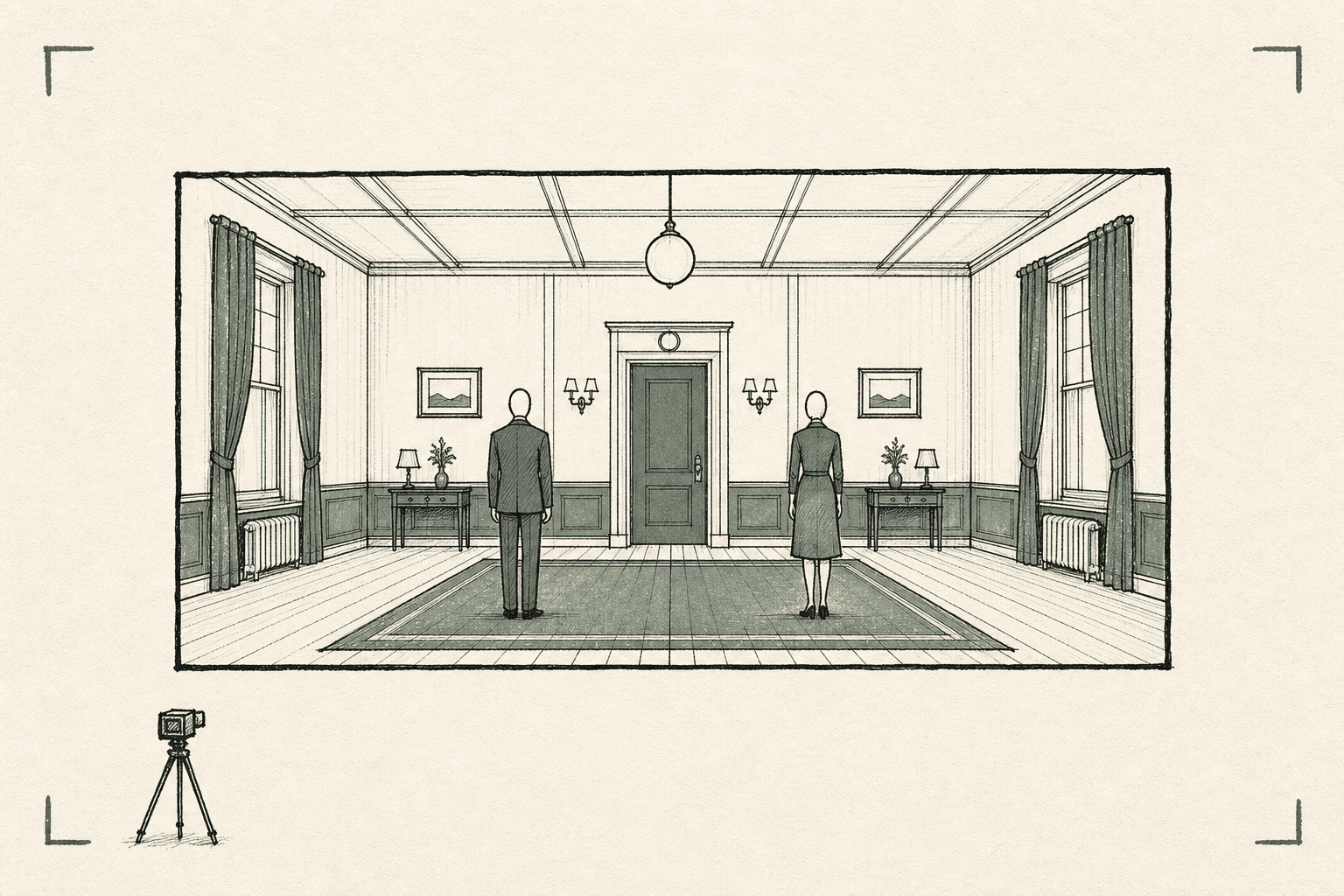
Storyboard note: "LOCKED OFF WIDE. No movement. No zoom. No cut for [duration]."
The Reaction Cut
Comedy lives in reactions. Often the funniest moment in a scene isn't the joke — it's someone else's reaction to the joke.
Board the reaction. Give it its own panel with a duration note. Don't let it get lost in coverage.
Reaction shots reliably extend audience laughter — the reaction gives the audience permission to laugh and a moment to process the joke.
The Slow Push-In
A barely perceptible dolly push-in on a character's face during an awkward moment amplifies the discomfort. (This technique also appears in horror storyboarding for a very different effect.) The camera slowly getting closer mirrors the audience's cringing lean-in.
Rate: Even slower than dramatic push-ins. 1-2 inches per second over 5-10 seconds. The subtlety is the point.
The Whip Pan / Quick Cut
For rapid-fire comedy (rat-a-tat dialogue, quick visual gags), the whip pan or hard cut between shots creates energy. Board these as rapid sequences with minimal duration per frame.
Storyboard approach: Board 3-4 frames in quick succession with notes: "RAPID CUTS — 0.5 sec each."
The Comedy Storyboard Difference
Comedy storyboards need information that dramatic storyboards don't:
| Element | Dramatic Storyboard | Comedy Storyboard |
|---|---|---|
| Shot composition | Yes | Yes |
| Camera movement | Yes | Yes |
| Duration notes | Optional | Critical |
| Hold/pause notes | Rare | Essential |
| Reveal timing | Occasional | Frequent |
| What to HIDE from audience | Rare | Central |
| Sound design cues | Optional | Important (silence is a comedy tool) |
The biggest difference: comedy storyboards must specify what the audience does NOT see as carefully as what they do see. Information management is the director's primary comedy tool.
Storyboarding a Comedy Scene: Worked Example
Scene: Two characters sit in a restaurant. A makes a confession. B is distracted by something behind A that A can't see.
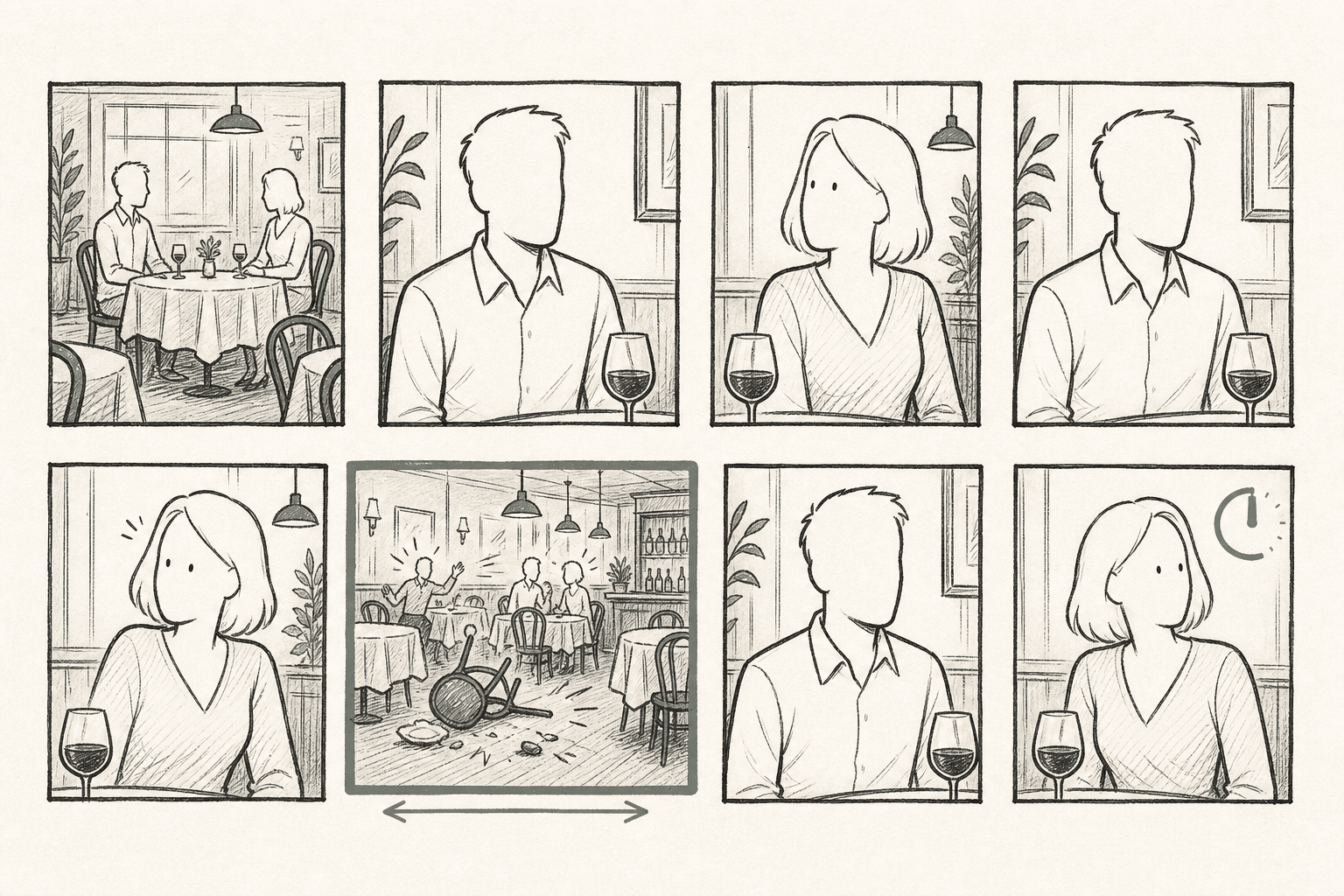
Panel 1: Establishing shot
Two-shot, both at table. Restaurant environment. Normal. Duration: 3 seconds
Panel 2: A begins confession
Medium close-up on A. Emotional, serious, vulnerable. Duration: 4 seconds of dialogue
Panel 3: Cut to B — but B is looking past camera
Medium close-up on B. Not making eye contact with A. Eyes tracking something off-screen. Slight concern on face. Duration: 2 seconds. THE AUDIENCE KNOWS SOMETHING IS WRONG BUT DOESN'T KNOW WHAT.
Panel 4: Back to A
A continues the confession, more emotional. Doesn't notice B's distraction. Duration: 3 seconds
Panel 5: B's reaction intensifies
Same framing as Panel 3. B's eyes widen. Mouth opens slightly. Still looking past camera. Duration: 1.5 seconds. BUILD CURIOSITY.
Panel 6: THE REVEAL — wide shot
Camera pulls to wide or cuts to a new angle that reveals what B was watching: [the visual punchline — a waiter on fire, an animal loose in the restaurant, a person doing something absurd]. Duration: 2-3 seconds. LET THE AUDIENCE ABSORB.
Panel 7: Back to A
Close-up. A finishes the confession. Completely oblivious. Awaiting B's response. Duration: 2 seconds. "So... what do you think?"
Panel 8: Hold on B
B, torn between addressing A's confession and the chaos behind them. HOLD 3 SECONDS. The internal conflict IS the joke.
7-8 panels. (See how many panels per scene for other scene types.) The comedy is designed into the storyboard through information control (what does the audience see and when) and timing (how long each shot holds).
Frequently Asked Questions
Ready to speed up your pre-production?
StoryBirdie turns your screenplay into a professional storyboard in minutes. See pricing or jump straight in.
About the author
Aayush is co-founder and director at StoryBirdie. He's a screenwriter, director, stand-up comedian, and full-stack developer — co-founder of Kathmandu's Comedy Tuk Tuk, with directing and writing credits on shorts, music videos, and comedy projects. He builds StoryBirdie on the conviction that storyboarding is expensive, time-consuming, and important — and that a tool for it should serve the filmmaker's vision, not replace it. StoryBirdie is currently in use on a Nepali feature, a Sri Lankan TV commercial, and at one of Nepal's largest production houses. Based in Kathmandu, Nepal.
Keep reading
- How to Storyboard for Animation: A Step-by-Step GuideStoryboarding for animation, step by step: timing, staging, acting through drawing, and the animatic pipeline. With real examples directors use.·8 min read
- Storyboarding for Documentaries: When and HowDo documentaries need storyboards? When to plan visuals, when to stay flexible, and how to storyboard the planned parts of your doc.·8 min read
- Storyboarding for Horror Films: A Director's Visual GuideHow to storyboard horror scenes that build dread, deliver scares, and control pacing. Camera techniques, framing, and visual storytelling for horror.·9 min read
- How to Storyboard a Commercial: A Director's WorkflowStoryboarding a commercial: timing, product shots, client-approval drafts, and the agency workflow that keeps clients and crew aligned.·8 min read